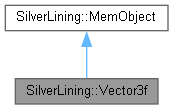
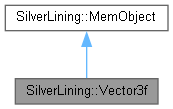
A 3D single-precision vector class, and its operations.
More...
#include <Vector3.h>
|
| | Vector3f () |
| | Default constructor; does not initialize the vector.
|
| |
| | Vector3f (const SilverLining::Vector3 &v) |
| | Construct a single precision vector from a double precision one.
|
| |
| | Vector3f (float px, float py, float pz) |
| | Constructs a Vector3f from the specified single-precision floating point x, y, and z values.
|
| |
| float SILVERLINING_API | Length () |
| | Returns the length of this vector.
|
| |
| float SILVERLINING_API | SquaredLength () |
| | Returns the squared length of this vector.
|
| |
| void SILVERLINING_API | Normalize () |
| | Scales the vector to be of length 1.0.
|
| |
| double SILVERLINING_API | Dot (const Vector3 &v) const |
| | Returns the dot product of this vector with the specified Vector3.
|
| |
| Vector3f SILVERLINING_API | operator- (const Vector3f &v) const |
| | Subtracts the specified vector from this vector, and returns the result.
|
| |
| Vector3f SILVERLINING_API | operator+ (const Vector3f &v) const |
| | Adds this vector to the specified vector, and returns the result.
|
| |
| Vector3f SILVERLINING_API | operator* (float s) const |
| | Multiplies this vector by a scalar and returns the result.
|
| |
|
| float | x |
| | Data members x, y, z are public for convenience.
|
| |
A 3D single-precision vector class, and its operations.
◆ Vector3f() [1/3]
| SilverLining::Vector3f::Vector3f |
( |
| ) |
|
|
inline |
Default constructor; does not initialize the vector.
◆ Vector3f() [2/3]
Construct a single precision vector from a double precision one.
◆ Vector3f() [3/3]
| SilverLining::Vector3f::Vector3f |
( |
float | px, |
|
|
float | py, |
|
|
float | pz ) |
|
inline |
Constructs a Vector3f from the specified single-precision floating point x, y, and z values.
◆ Dot()
| double SILVERLINING_API SilverLining::Vector3f::Dot |
( |
const Vector3 & | v | ) |
const |
|
inline |
Returns the dot product of this vector with the specified Vector3.
◆ Length()
| float SILVERLINING_API SilverLining::Vector3f::Length |
( |
| ) |
|
|
inline |
Returns the length of this vector.
◆ Normalize()
| void SILVERLINING_API SilverLining::Vector3f::Normalize |
( |
| ) |
|
|
inline |
Scales the vector to be of length 1.0.
◆ operator*()
| Vector3f SILVERLINING_API SilverLining::Vector3f::operator* |
( |
float | s | ) |
const |
|
inline |
Multiplies this vector by a scalar and returns the result.
◆ operator+()
| Vector3f SILVERLINING_API SilverLining::Vector3f::operator+ |
( |
const Vector3f & | v | ) |
const |
|
inline |
Adds this vector to the specified vector, and returns the result.
◆ operator-()
| Vector3f SILVERLINING_API SilverLining::Vector3f::operator- |
( |
const Vector3f & | v | ) |
const |
|
inline |
Subtracts the specified vector from this vector, and returns the result.
◆ SquaredLength()
| float SILVERLINING_API SilverLining::Vector3f::SquaredLength |
( |
| ) |
|
|
inline |
Returns the squared length of this vector.
| float SilverLining::Vector3f::x |
Data members x, y, z are public for convenience.
The documentation for this class was generated from the following file:
 1.13.2